Thank you!
Oops! Something went wrong while submitting the form.
Cancel

.png)
Several years back I was bringing a new board member up to speed on Nexon’s business. He asked to see our product plan so he could understand how we were making creative decisions. It was a perfectly reasonable corporate governance request. I sent him our management team document with the full product lineup, spend-to-date, estimated launch dates, links to gameplay footage, and development status. A week later, after considerably more explanation and discussion, he said, “Look, I don't know how to judge what you sent me, or whether any of these games are any good. All I know is you're spending a lot of money.”
He was precisely right: a) we were spending a lot of money, and b) he had no way to assess the likely success of any of the products. He knew next to nothing about videogame development. I spent a lot of time with him on each product, and I learned (and I sense he recognized) that it would be very difficult for him to understand why our investments made sense.
At first, my management team and I were frustrated. There was something vaguely Kafkaesque about an overseer candidly admitting that he could not understand what he was overseeing. But he had identified a real problem: without understanding the products and development process, he was in no position to evaluate the investment plan.
Over time I realized his questions were valuable, but in an unexpected way. If I could convince him that our strategy made sense, I could probably convince equity analysts and portfolio managers. His skepticism and naivete about game development made him a useful proxy for the people who moved our stock price, so he was valuable for “red teaming” our IR messaging.
But what he blurted out is a microcosm of one of the biggest problems in our industry, replicated around the world in board meetings, management team debates, HR decisions, and investor relations: how do you evaluate what you don’t understand?
When Tynan Sylvester built RimWorld, he did every job in a game company himself. He made the game. He sold it: the website, the trailer, the press. He secured the resources it needed, mostly several years of his own time. And he designed the operation itself, deciding how all of it fit together. He could make every tradeoff in his head, where the whole business lived.
A big game company divides that one head into departments: the people who make the game, the people who sell the game (marketing, PR, business development), and the people who secure the money and talent everyone else depends on (finance, HR, legal). There is also a fourth job: someone has to design the company itself, how people, capital, technology, and incentives fit together. That is the CEO's real job, because it is the one job that architects the machine rather than working inside it. Management is the work of making tradeoffs across all of these.
Up to a point, an executive team that can communicate across domains can manage the cost of complexity. EA’s exec meetings in the early 2000s were often contentious and uncomfortable for everyone present, but those confrontations enabled the company to make smart decisions.
But you can’t make tough tradeoffs if you don’t know what your colleagues even do. A shared word does not guarantee a shared meaning.
So when I say these groups speak different languages, I don't just mean they use different jargon. They have different concepts in their heads. A term like “retention,” “creative vision,” “opportunity cost,” or “technical debt” carries a whole model of how the world works. If you don't have the underlying concept, hearing the words is of little help. Eventually the models diverge enough that intelligent people can look at exactly the same facts and genuinely see different things.
When people don't understand a foreign language, they often repeat the same thing louder. Anyone who has lived in a foreign country has cringed at their countrymen doing this in a grocery store or a restaurant. Companies do the same thing, but with the added sophistication of graphics and sizzle reels.
And when people can't judge an idea, they judge the person presenting it instead: confidence, polish, whether the person agrees with them. Politics flourishes in such an environment. People who understand the language know that some of the least eloquent people in the room can be the most valuable.
When a company’s marketers can’t fluently communicate with its developers, launch positioning often goes wrong. We committed this foul years ago at Nexon when publishing EVE Online in Japan. The game itself is deeply cerebral and strategic, but the advertising videos had thrilling music that sounded like something from Star Wars. It didn’t go well.
Companies that are unable to communicate internally make their worst decisions when firing. Finance teams can see that a studio is losing money. The developers know which people inside it are nearly impossible to replace. Shutting down a poorly performing studio can look sensible financially and still be devastating to the people affected. It can also be disastrous for the company if it scatters people with rare skills it badly needs elsewhere. Vince Zampella once told me how lucky he felt to pick up several exceptional sound designers for Titanfall 2 from a studio EA had just closed (this was long before their later acquisition by EA).
It’s easy to think of HR as managing compensation and benefits, recruiting and firing, and administering stock options. Those activities are difficult and specialized, but they are methods, not the objective. HR’s real job is to find exceptional people and enable them to do the best work of their lives. Seen from the CEO’s chair, that makes HR arguably more strategic than M&A. Yet too few HR professionals in large game companies have enough fluency in development to understand what exceptional developers need. Sports talent scouts are often former players. K-pop recruiters are often former entertainers. How many senior HR professionals in the game industry come from development, or are at least serious gamers?
A reliable tell is someone who can explain how a policy works but not why it exists. The explanation usually ends with: “That's how it's done” or “It's a best practice.”
If insiders struggle this much to understand what they and their colleagues do, outsiders have little chance.
In the mid-2000s I spent about two hours walking the floor of E3 with Mary Meeker, one of the most respected and insightful analysts and investors in technology and media. Passing by the Sony, Microsoft, and EA booths, surrounded by the eye candy and cacophony, she remarked, "Boy, we're really at the point at which video games are as good as Hollywood." On the surface she was right. But she was looking at games through a Hollywood lens and missing what made them games: the systems and rules that let players make decisions. Player agency, not a surface resemblance to movies, was driving the industry’s growth. If even the smartest analysts can't distinguish a sound $100 million investment from a $100 million bonfire because they don't speak the language of games, they will misprice the assets they are investing in.
To see the impact of this mismatch in the real world, look at how different people can see the exact same investment.
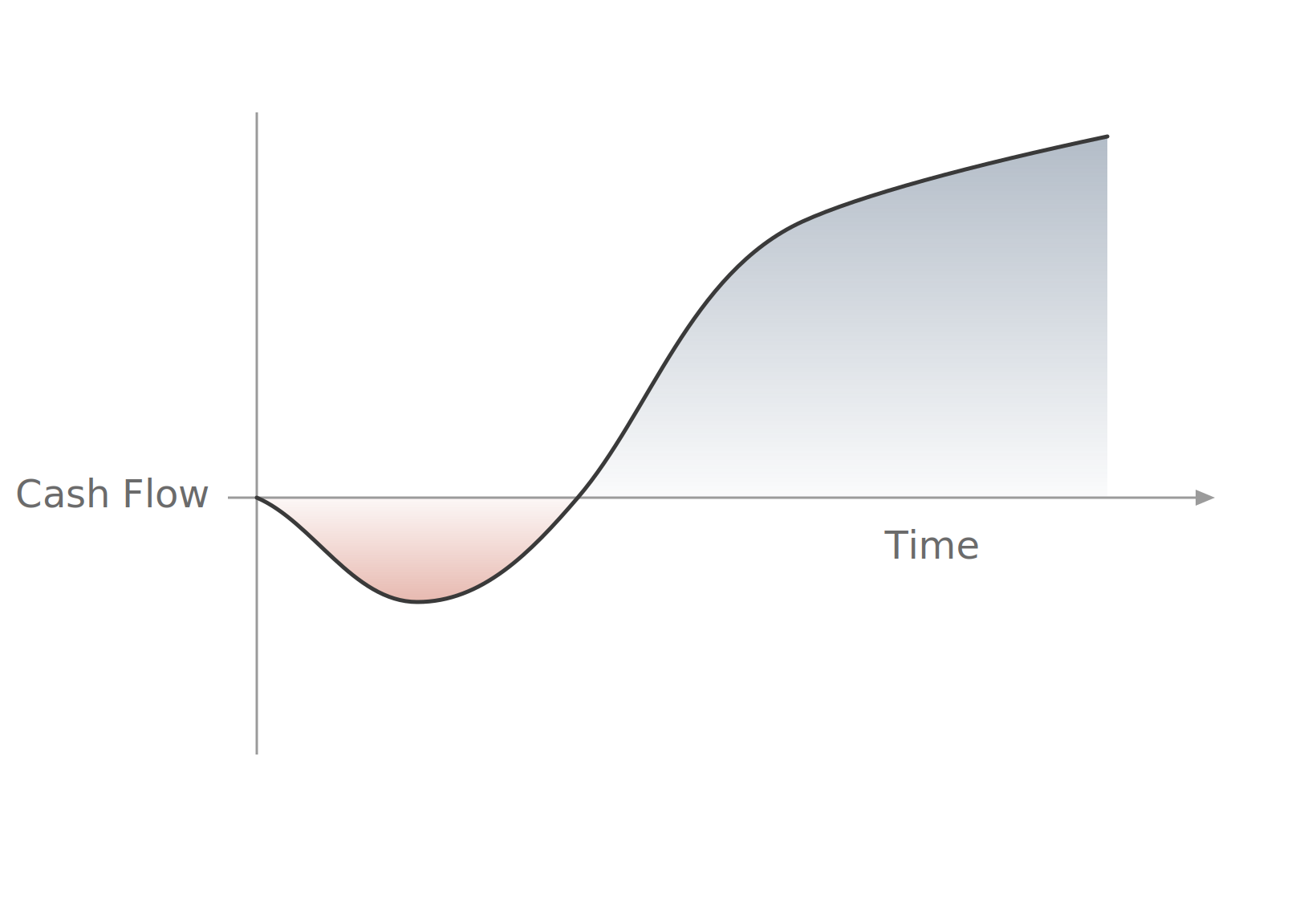
Business decisions are at their core investment decisions, and most of them boil down to some version of the question: how much do I have to put in now, and what are my chances of getting substantially more back later?
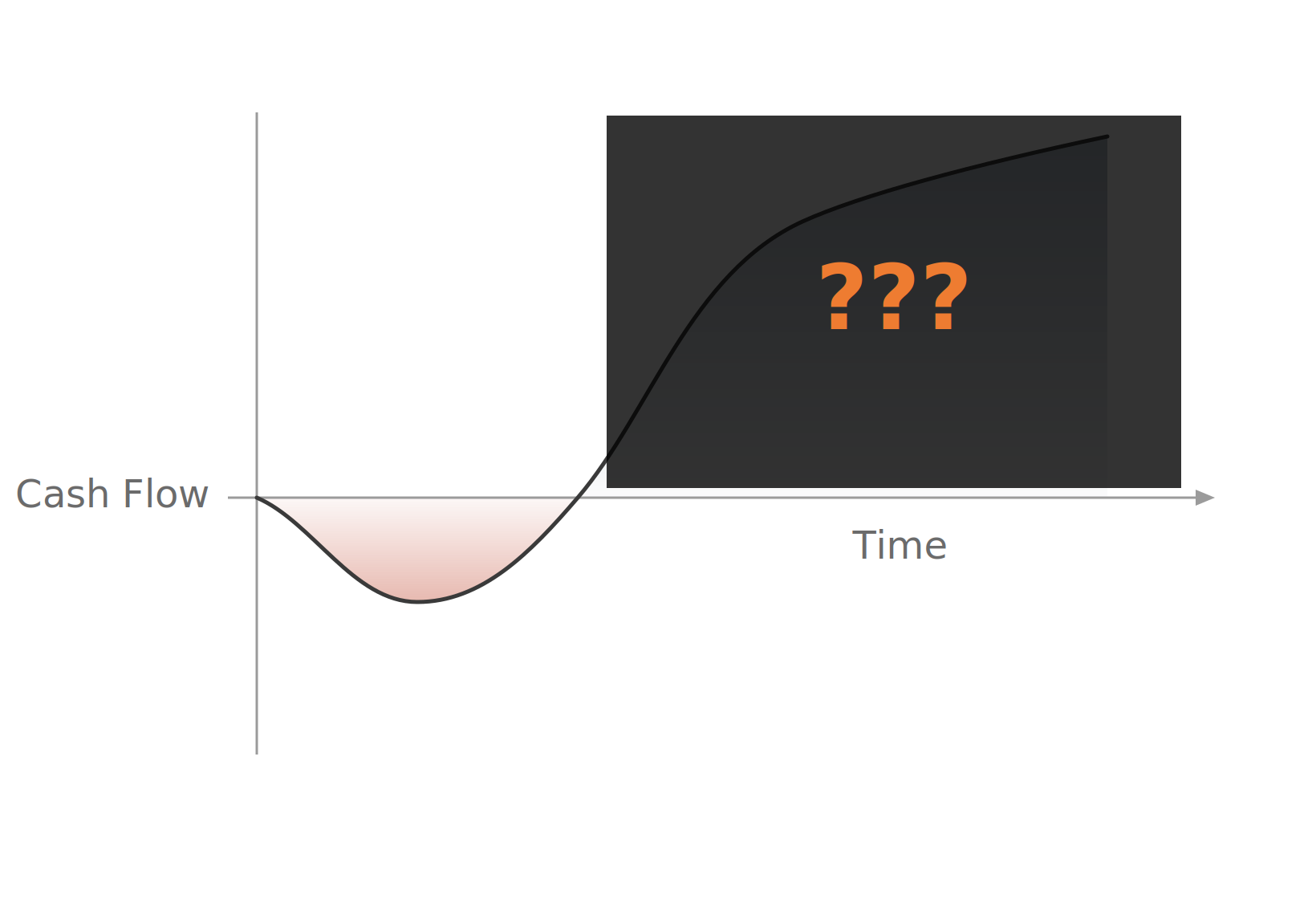
The finance team understands the investment side: salary, headcount, burn, budget variance, and schedule. The potential return is harder to see because fun, retention, product quality, and the value of another six months of iteration are much harder to evaluate. So they rationally gravitate toward what they can measure: cost.
Developers have almost the inverse problem.
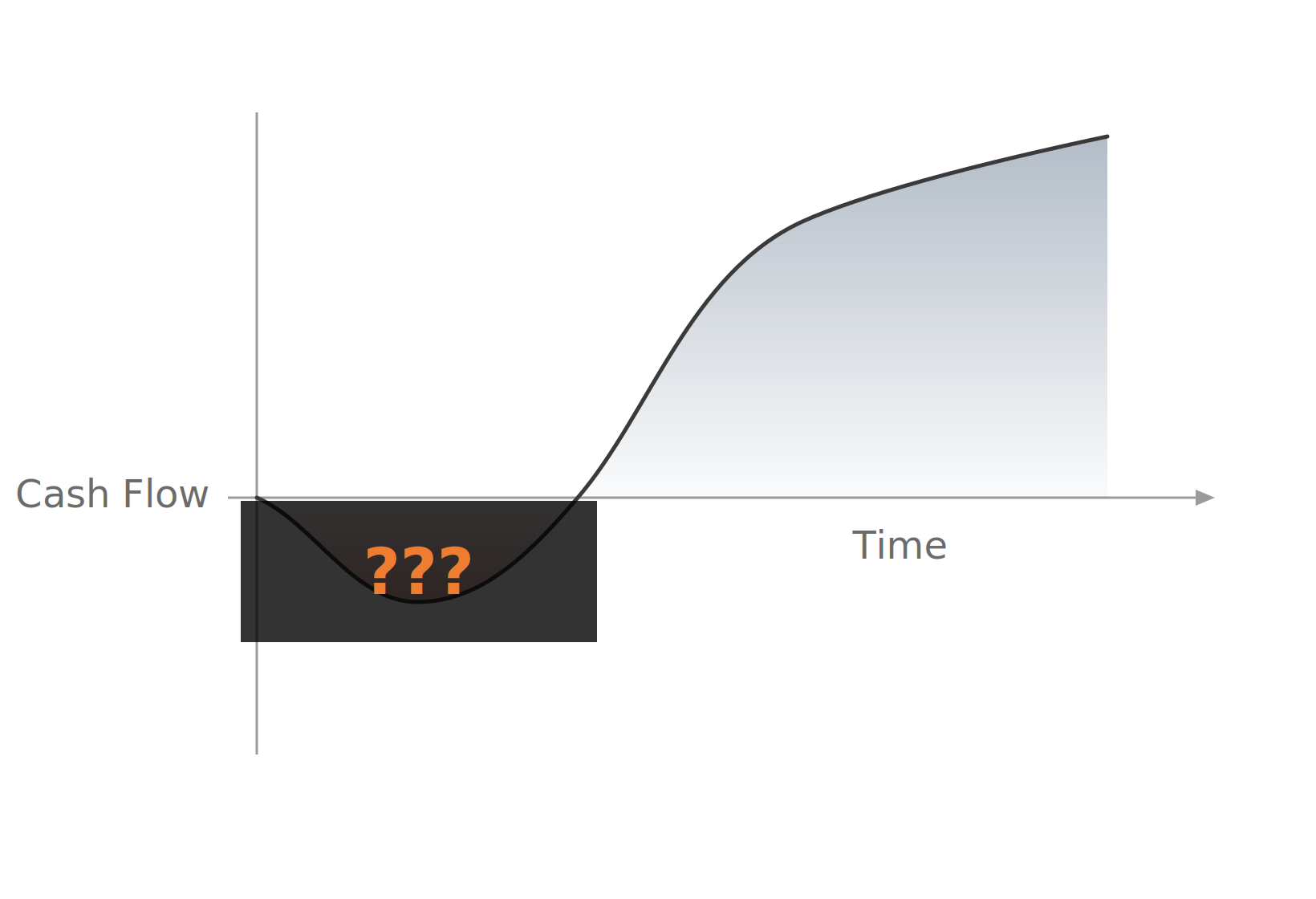
They can see why a game mechanic needs another iteration, why the combat isn’t working, or why the art direction isn’t coherent. But they often do not see the full cost of another six months: the capital, the opportunity cost, and the projects that money cannot fund.
Both groups are behaving rationally based on the part of the reality they are fluent in. Finance isn't stupid for worrying about the $100 million it can see when the claimed $500 million upside is a black box. The developer isn't stupid for wanting another six months if she can see that a core system is broken and knows the game will fail without fixing it.
The nature of developing and growing videogames makes this problem a lot worse than in many other industries. A railroad engineer can tell a capital allocator a great deal about what an additional $10 million buys. In games, another $10 million might make the game a lot better, accomplish almost nothing, or actually make the game worse. The return curve is much harder to predict in games because the causal relationship between spending and value creation is hard to understand for someone who isn’t reasonably fluent in game development.
As firms grow, control often passes from builders to professional managers. Their distance from the underlying work makes difficult tradeoffs harder to make. Decisions slow down as every domain struggles to translate its case into terms other managers understand. Boards often sit at the extreme: furthest from the underlying work, with authority over the largest tradeoffs.
Games are uncertain, but uncertainty is not the same as randomness. Chance plays a major role in any creative endeavor. The problem with “it’s a hits-driven business” is that it ends the discussion without helping anyone make a better decision. It is surrender.
With this much getting lost in translation, it’s a wonder we built a $200 billion industry. It is less surprising that its largest companies have struggled to grow.
In college I moved to Japan to study the language. One night my girlfriend took me to dinner with her parents and sister. Her mother was Japanese, her father American, and the family moved between the two languages in the same sentence. All of them were playful in both languages. The sisters clearly thought English worked better for giving their parents a hard time. I had been treating Japanese and English as two separate ways of thinking. For them it was one. They didn’t have to translate in their heads. They were treating the combination of languages as one much larger domain of expression.
Years later I recognized the same multilingual approach in the best executives I have worked with. They can move between product, finance, and technology without treating them as separate worlds. Like learning a language, that takes a willingness to sound dumb or childish for a long time. At Nexon I learned to ask the same question three ways, of three people, before I trusted that I understood the answer.
People who can think across domains stop accepting the dogmas of any one of them. They start asking creative questions that people inside the silo either haven’t considered or would prefer not to address. Why are we organized this way? Why is this tradeoff necessary? Why does this game require 600 people and five years? Can we do things differently?
Mitch Lasky is a great example of a polyglot in the games industry. He started as a lawyer at Disney but was more interested in the then-new area of online games, and in digging around the back halls of the Tokyo Game Show looking at the latest Japan-only otaku games. His career eventually took him through publishing, running studios, mobile games, and venture capital. A conversation with Mitch about a company’s prospects flips playfully between game design, distribution, and financing. To him, they are all part of one broader domain.
In a game company, a little multilingualism goes a very long way. Specialists don’t need to be able to do every job. They need enough fluency to engage meaningfully in the discussion.
So what do you do when you're responsible for domains you will never speak natively? There are only a few honest options.
You can trust the people who are fluent, which is uncomfortable, because you're trusting them partly because they can talk to you, the way a traveler trusts whichever local speaks English. If you go that route, you have to design incentives so carefully that you can survive not understanding.
The better answer is to become as fluent as you can in every domain, because making tradeoffs across them is what leaders are paid for. But the best answer is to augment your own fluency by hiring polyglots at every level, because every one of them lets a decision be made further down, where the knowledge lives, instead of escalating to the top. A company where all the tradeoffs rise to the CEO does not scale.
Take an artist who understands the game's creative core, why the schedule is what it is, and what another week of work costs. She can help the team decide whether to keep polishing an asset, invest in a new tool, or move on to something the game needs more. Those tradeoffs are already in her head, so she can reason through the decision quickly and communicate with the rest of the team much more effectively.
Polyglots matter most when the technology changes, when the old rules break and disciplines recombine. If you understand only finance, AI looks like a way to reduce cost, and its creative possibilities are invisible. You cannot rebuild a company around a technology this important in one language.
I arrived at Nexon in the summer of 2010 as the new CFO, with a mandate to take the company public, fast. After almost a decade at EA’s highly professional finance department, Nexon did not at first glance look ready for prime time. Its ugly Excel spreadsheets covered dozens of entities and regions in a convoluted chain. I thought we might need to overhaul the accounting system just to go public.
Early in my first month I met a casually dressed accountant in our Seoul office named Jihwan “Ken” Sheen. I asked for a regional view of how much cash we were investing and generating around the world. He said he would be back in a few minutes, and I expected him to return with a few other people so we could plan the project. Instead he returned three minutes later with a piece of paper and asked, “Is this what you need?” It was exactly what I needed. His ugly spreadsheet was in fact a sophisticated pivot table powered by a deep Oracle instance. Over the next two hours, every question I had produced a deeper answer. I had been judging the veneer because I could not yet read the system underneath it.
Ken’s fluency mattered most when we prepared our quarterly guidance. At a public company, miss your own forecast and investors conclude you either don't understand your business or can't run it.
To make sure we got it right, each quarter before earnings we conducted a series of “revenue attainment” meetings, a rigorous review and forecasting exercise. Ken and the rest of the team came equipped not just with analysis but with a deep understanding of the games and what drove them. Ken had played MapleStory in his youth and was now playing it even more with his young son. The rest of his team regularly played all our biggest titles. They knew exactly what was going on in the games.
During my time at Nexon, we never missed our quarterly guidance. That consistency earned credibility with our board and shareholders, which gave us room to make a number of highly unconventional and ultimately successful decisions.
Ken and his team were not merely good accountants. They understood both the investment and the likely return. They spoke both languages.