Thank you!
Oops! Something went wrong while submitting the form.
Cancel

.png)

In late 2000 I joined EA’s Corp Dev team and shortly later was promoted to run the group. I was in way over my head. I had been an operating manager at much smaller companies prior, not an M&A specialist. The EA execs all seemed skilled at finding the smallest error in any analysis my team and I produced, and at reminding me I was lucky to have the job. I had thought I was joining an industry of creativity and whimsy, and instead found I was in a gladiator academy of macho math graduates.
What I quickly realized was that the exec team didn't just know the games in the industry, they knew everyone in it: the personal stories, motivations, and dirty laundry. My presentations on the numbers and the IP quickly turned into discussions about the people and whether they could be depended on. As a rookie among titans at the top of their game, I sounded dumb most of the time.
Despite the dominant position they had built, EA had just come off a string of multiple unsuccessful acquisitions. I met a lot of game company founders, and their response was deafening: EA’s most recent acquisitions had resulted in studios destroyed and beloved games cancelled. My listening tour turned into an apology tour.
Back at the home office, the self-flagellation was even worse. I asked as many colleagues as I could about how the company worked and what needed to improve in M&A. Two separate execs told me the answer was “Do less M&A.”
It was a rough start, but it perfectly teed up a conundrum the industry has been grappling with for at least the last 25 years.
To buy a company you have to figure out how much it’s worth to you. And then you need to figure out how you are going to ensure it is worth that much after you’ve bought it. That’s it. Everything else is a method.
It could be so simple. But it’s very difficult in the real world.
Shareholders usually have a very simple objective: they want the value of their shares of the company to go up year after year. Bad M&A frequently is a result of the dealmaker (CEO, CFO, Corp Dev head) having a different agenda than his/her shareholders. The phenomenon is known as the Principal-Agent Problem: managers act as agents of the owners, but have different incentives and do not bear the full economic consequences of their decisions, while owners end up with the residual risk.
The Agency Problem is much more common than anyone cares to admit, so it’s worth understanding the psychology behind it.
For one, dealmakers are usually operating under specific near-term financial incentives, such as bonuses for revenue, profit, or stock-price growth. The incentives aren't only financial: a deal is a tangible demonstration that the CEO has a strategy, and a board will think twice about firing the CEO right after a big one.
More subtle are the social pressures. Corp Dev people commonly believe they get paid to do deals. They rarely stay at the same company their whole career, and a list of deals is a claim to fame. And, when executives see a competitor buying another major company in the industry, the FOMO is real.
Beyond the incentives, the tools and process of dealmaking often set executives up to fail. Discounted Cash Flow, accretion/dilution, and “football charts” of comparable transactions can make a terrible deal sound great. They are rear-view metrics that don’t predict the future, and they are only as good as their (often bad) assumptions. And deals are almost always done on a highly compressed timeframe that constrains deep thinking and analysis.
Finally, a strategy built on M&A rests on something you don't control: there may be nothing worth buying at the right price for years at a stretch, and if you want to grow, you may be stuck between doing nothing (and looking idle) or doing a bad deal (and looking busy).
Some combination of these pressures operates on the buyer and seller in almost every deal, and often feed off each other in a self-reinforcing system. I’ve been in dozens of pedantic debates about the appropriate interest rate on the discounted cash flow (a tool) because of a fundamental disagreement about whether to do the deal, which was really an argument about differing incentives.
The fallout from these pressures and structural realities has led to massive carnage in the industry, in a way that nobody intended and nobody wants.
Destruction of Jobs: The most obvious and hurtful is the thousands of layoffs. Certainly the industry’s layoff waves have not stemmed solely from M&A, but it is fair to say that sloppy M&A has exacerbated the industry’s woes rather than being the solution.
Destruction of Capital: Shareholders are ultimately individuals, either directly or through investment funds. The abstract-sounding "capital" really means someone's hard-earned money. What’s the rational thing for them to do when execs screw up M&A? They dump stock.
Destruction of Focus: Making good games is exceedingly difficult, requiring enormous management brainpower. Squandering this scarce asset on bad M&A can easily make everything else worse.
To illustrate the fallout, look no further than Embracer Group.
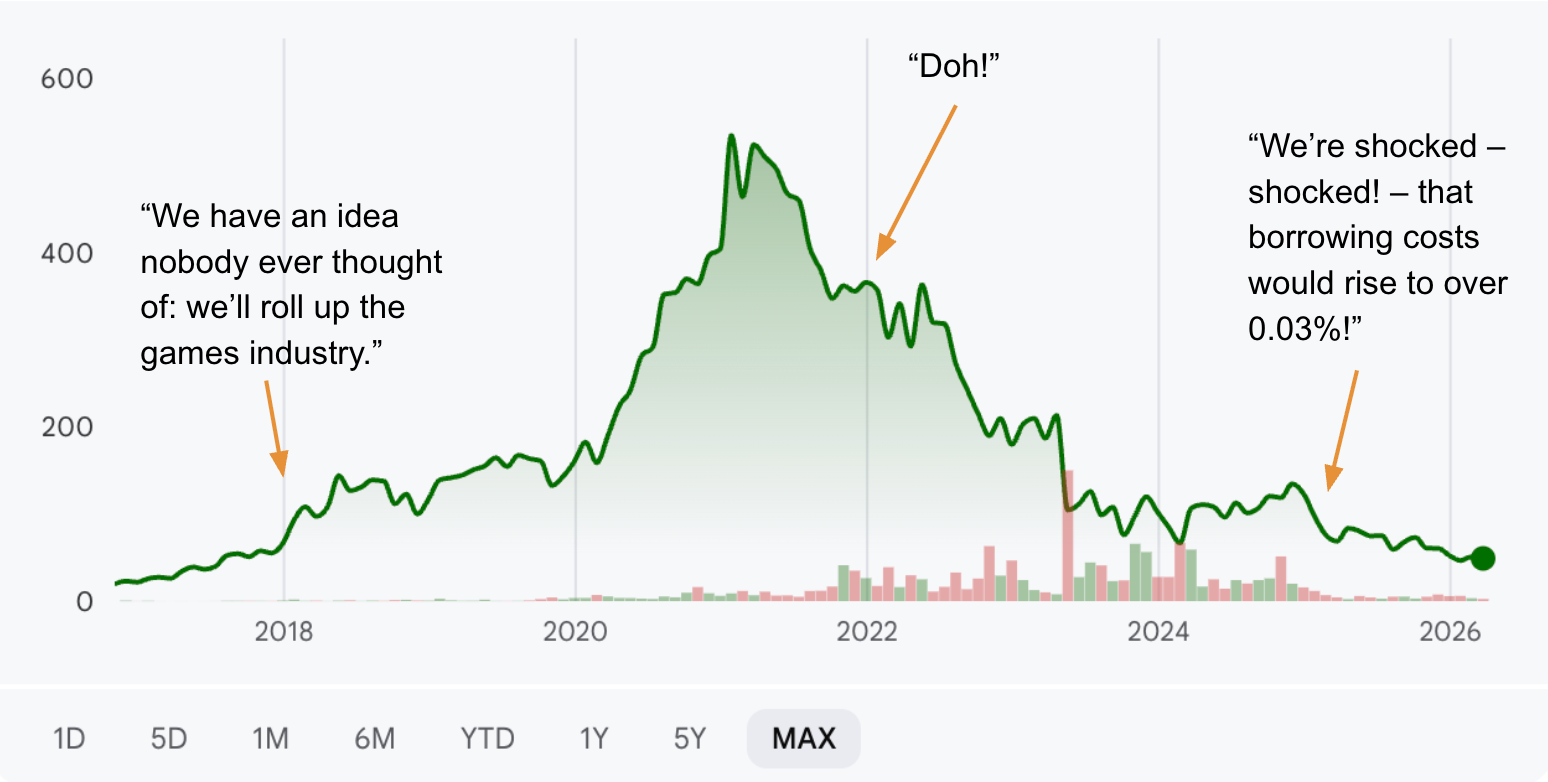
From 2018 to 2022 Embracer Group – a Nordic distributor and publisher of box games – hoovered up over 80 game companies, including Saber, Gearbox, Crystal Dynamics, Coffee Stain, Aspyr, Eidos, Asmodee, and the THQ Nordic catalog. By the time they were done they owned over 900 franchises, including Tomb Raider and Lord of the Rings. Their appetite and speed were astounding, and seemed to achieve the dream of countless private equity tourists to “roll up” the games industry. For about 3 years they looked smart.
And then it all came crashing down. As the debt accumulated, as the acquired companies underperformed, and as historically cheap capital dried up, the cost of carrying all those companies overwhelmed Embracer’s ability to pay. They had thought that running the PE rollup playbook would work when backed by diversification and cheap borrowed money. That’s a fine approach in stable and predictable cash flow businesses like cable TV in North America in the 1980’s; it’s a terrible playbook in a hits-driven, long-cycle, massively complex, people-intensive business like videogames.
One explanation offered at the time was that the company’s exec team was surprised by interest rates rising. But serious capital allocators with any memory or interest in history knew we were living in an unprecedented low interest rate environment; their strategy was no more sophisticated than a young family stretching to buy a house with a “teaser loan” that would certainly rise after a couple of years.
There's a chance Embracer's disaster has a silver lining. In 2025 the board hired Phil Rogers as Group CEO. Phil joined my group at EA when we acquired Criterion from Canon in the mid 2000's, and while at EA he did months of work to formalize our integration playbook, how we aligned the people in the companies we acquired. He went on to run Eidos and then Square Enix's Western studios, living the problems from the operator's chair. He's cleaned up a lot of capital allocation messes.
Before I go further, I should emphasize I have made my share of mistakes and most of what I’m writing here comes from those hard lessons. Some of my mistakes were small and forgivable, but I made some big ones too. In one while at Nexon, I spent far too little time with the sellers of a casual games company we acquired – largely leaving the task up to my corp dev team – and I therefore had very little idea what was motivating them. I ignored the signals that they were trying to cash out and wouldn't stick around after the acquisition. As a result, I was left with an ugly and time-consuming management problem when several key employees left soon after the deal closed. My mastery of the tools of M&A did not help me at all when I allowed myself to become subject to the wrong incentives. My stupid mistake cost my company a lot of money and a lot of focus, and remains deeply embarrassing to me.
It's easy to mock these mistakes and the fallout. The people doing such acquisitions are not venal and did not intend that outcome. The problem is they are a product of the incentive systems they work in. When a system consistently produces this much wreckage, it's worth asking whether the people following its rules are the sane ones. Don't hate the player, hate the game. But hate the player for not changing the game.
Like architecture firms and law partnerships, the company is just the piece of paper that links a set of people. It is a map by which they act.
It’s easy to look at a company and see a company. Instead you should look at a company and see a club. It is a collection of people who choose to be together at a point in time. You are not buying a factory that runs itself. They are living humans with emotions and motivations, and if those circumstances change the output will also change. You may end up with nothing.
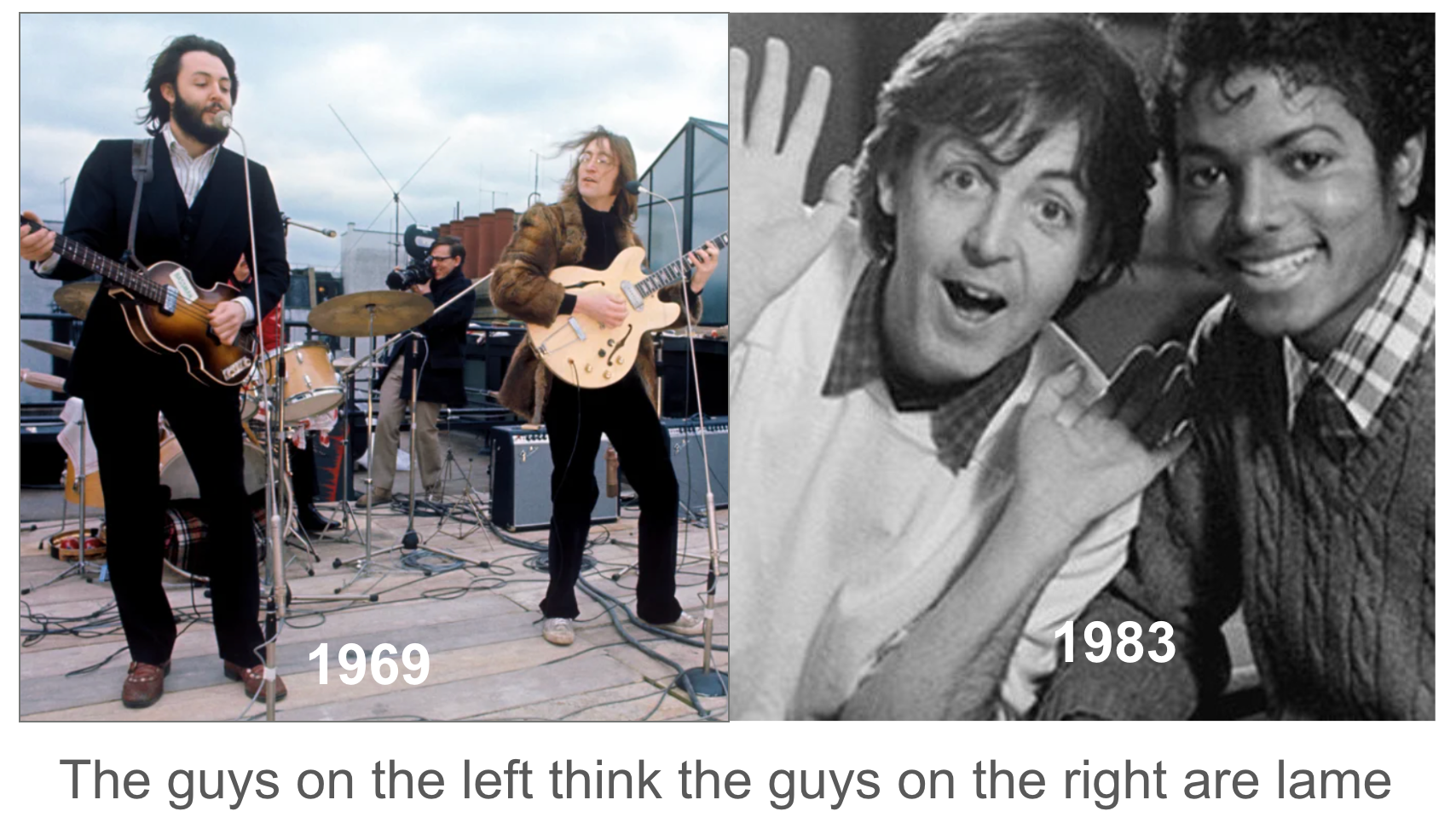
While at EA I started thinking of this as “The Paul McCartney test.” In an acquisition discussion, am I talking to Paul McCartney of 1969 (angsty, competing with John, a lot to prove, fierce work ethic) or Paul McCartney of 1983 (content and settled, little left to prove, caring about his legacy). 1969 McCartney made Abbey Road. 1983 McCartney made “Say Say Say.” 1969 McCartney is what you want to buy, but it is more than likely you end up with 1983 McCartney. And the very act of buying that creative person's company automatically transform that person in the wrong way.
The heuristic is not really about age, it’s about hunger. A lot of young people are not very creative. A few older people are very creative. Clint Eastwood’s best work was done after the age of 62, starting with Unforgiven. He had more to say as an old man than he did in his 20’s.
Tynan Sylvester wrote extensively about this phenomenon in the context of games: "The better people are, the harder they are to motivate. Uninterested, mediocre developers don't feel dissatisfied working on uninteresting tasks because disinterest is their default state. They're like pig iron handlers; they work purely for the cash. Great designers, on the other hand, live on top of an uncontrollable mental wellspring of ideas and ambitions. They must express these impulses or they grow unhappy."
Once you adopt this human-centered lens, everything about how you do M&A changes. Your revenue forecast starts to feel very fragile.
Once you see a studio as people rather than a P&L, the deal stops being merely a transaction and becomes more like a tree you plant: fragile at first, stronger over time, with the payoff arriving long after the work. So the metric that matters isn't size of deal or near-term accretion. It's ROI: what you paid against what you get back over the years after the deal is closed.

And ROI gets far easier when the two companies make each other stronger. Bankers like to call it "1+1=3," an overused term for an under-exploited idea. When EA bought DICE, we knew we could sell more Battlefield than DICE could alone, and that their management would lift our studios. Boy did we underestimate on both counts, and got enormous ROI for many years for very little upfront spend. The best example I know in entertainment is Pixar/Disney, which we got to study closely when Kevin Mayer (who did the deal with Bob Iger) joined the Nexon board. Disney didn't just buy Toy Story and Finding Nemo. It bought Lasseter and Catmull, who were far more talented and dedicated to the original Disney spirit than what Disney had become, and who revitalized its creative engine. And Steve Jobs joining the board meant the Pixar spirit would infuse Disney rather than get crushed. The cash flows were important, but it was the people who brought Disney Animation the creative renaissance that lasted at least a decade.
You buy the company twice, once for the company, and once for the people. The equity you bought is just a call option on the privilege of convincing the developers to show up the next morning, with a smile. Your forecast is worth nothing if they don't.
So the leverage inverts at close. The day before, the buyer holds most of the leverage: they can simply decline to write the check. The day after, the sellers get the leverage. If the key people leave, the rest usually follow, and you're left with an empty box, explaining to your board how a deal that looked smart last month became a management crisis this month.
That changes what diligence is. Accounting and legal work matter, but they're mechanical. The real question is what the company will produce next, which means understanding the people who'll produce it. A&R people at a music label and sports scouts obsess about such things. Game industry M&A people rarely do. And the numbers fool generalists: revenue is a derivative, a lagging shadow of things like retention and quality. A game's revenue can climb for years on a player base quietly eroding underneath it, which means a buyer who can't read retention is buying a melting asset.
Even the negotiation is inverted. Buying a game company is mostly selling. To get a great game developer, you have to sell the seller on selling to you. The first rule of selling is to listen, and here the buyer is the seller. A surprising number of professional dealmakers never grasp this. In the early 2000s Mitch Lasky invited me to jump from EA to Jamdat after we tried to invest in them. I told him I wouldn't want to buy his company, so why would I go work for it? He didn't take offense. He spent the next few hours walking me through why mobile was going to be the most important platform in entertainment and why Jamdat would be the leading games company on that platform. I spent the next several months selling him on coming to EA and EA on buying Jamdat.
Seller Motivations: Bing Gordon points out there are actually three different founder motivations that can animate a good deal. I’ve spent most of my time on the first: the founder stays on mission with better backing than they had alone. Outside of games, Don Katz built Audible inside Amazon for years after selling, and it became the dominant thing in its category.
The second is when the founder takes on a bigger job at the acquirer. John Hanke sold Keyhole to Google and went on to run Google Maps. Facebook bought drop.io and made its founder Sam Lessin a senior product leader. Kevin Mandia sold Mandiant to FireEye and became its CEO. In each case the acquirer got both the company and a leader who could run something bigger.
The third is the founder who wants to take the money and go. Bobby Kotick ran Activision for decades, sold to Microsoft, and stepped away. This is a legitimate outcome if that’s what everyone plans for, a potential disaster if it’s a surprise.
Structure is downstream of motivation. If your objective is to retain the team, you must figure out how to motivate them to build the combined company. There are many techniques, but the simplest way is to pay a meaningful share of the purchase price over time, and in stock.
The negotiation then becomes its own due diligence tool, the Tell. A mercenary seller treats an earn-out as purgatory and pushes for all cash upfront. A seller who believes in the combined company will trade away near-term cash for bigger upside, especially in stock. All negotiations are difficult; where the other side chooses to be difficult tells you volumes about their intentions.
Post-deal integration augments or destroys all of this. Integration isn’t about Oracle, office space, and HR systems. It's about maximizing the combination in whatever form makes sense for this group of individuals coming together. Destroy the seller's culture and it stops producing the thing you paid for. When Take Two acquired Zynga for $12.7B, the analysts were skeptical. But Strauss Zelnick is highly skilled at structuring incentives to keep talent motivated, and Frank Gibeau's team were the most effective mobile operators in the US at the time. Whether or not it was a core objective of the acquisition, the deal bought time for Strauss’s decade-long bet on GTA6.
Handling all this deftly is hard to do, especially in a compressed time frame when the two sides don't even know each other very well. It can be very much like a shotgun wedding, but with a lot of people involved instead of just two. In this sense minority investments are badly underused. Done well, they buy years of close observation. Tencent has been the master of this approach of dating before getting married for over a decade. Western acquirers squander the opportunity by demanding a "path to control" up front. But path-to-control can be much more damaging than it is useful. Asking for it is like telling someone on a third date that you want to move in together. Few good sellers will say yes, a meaningful number will be driven away by the very question, and the ones who do say yes are often the ones you need to avoid.
This is lonely work. Little of this is legible to deal junkies. The results won't show for years, getting the people dynamics right earns no credit when the press release goes out, and the whole thing looks like wasted time. But it’s where the real ROI is won or lost.
And it runs both ways: the best leaders I've sat across from spent as much time sizing me up as I spent on them: whether I'd still be there in five years, whether I wanted the same things they did, what I would do to make the combination work.
In the spring of 2017 Nexon was in a quandary. We built our business by making games like MapleStory, Dungeon & Fighter, and FIFA Online last and grow indefinitely: our live operations capabilities were as good as anyone on the planet. The AI experiments we started were beginning to have tangible impact on our growth. But we were struggling to launch new games that would resonate, especially in the West. We had made a few small acquisitions that did not pay out, and we had been outbid on two big ones that at the time were slightly too big for us to afford: Riot (creator of League of Legends) and Mojang (creator of Minecraft). Outside of those, over a ten year period there were almost no other companies we wanted to buy even as our cash position grew rapidly.
That year I reconnected over coffee with Patrick Soderlund, who by then had stepped away from EA. We had been friends for over a decade at that point and I knew him to be not only one of the most creative, driven and savvy studio heads in the games industry, but also an exceptional human being. In a follow up call he let me know he was taking some much needed time off with his son and two college friends at his house in Mallorca and invited me to meet him there. I was on the next flight over.
Over a three day weekend, filled with watersports, seafood, and some great wine, we talked deeply about the industry, Nexon, and the future of games. It was an enjoyable vacation, but under the surface was pure dealmaking. We both had an agenda.
I wanted to assess whether our interests were aligned: what kinds of games did he want to make after Battlefield? How did he want to make them? Was his head in the game or was he less motivated than in his youth? I was testing his ability to help Nexon’s goals.
Patrick was testing me at least as much, if not more. He wanted to go about development in a very different way. He had lived through a decade of AAA grind of massive budgets, and felt technology could be used to get developers much closer to the creative process, rather than managing teams of hundreds. He wanted a little time and money to get it right and felt it would pay off a hundredfold. And he wanted to branch out with new play styles and a new creative approach. So he needed to know whether I had the political wherewithal with my board, and desire to see this whole thing through. And his two Swedish college buddies and his six-year old son were his impromptu due diligence team. They were sizing me up to see if I was just another cynical suit. I knew they would report their views back to him. They knew Patrick was making not just an important business decision, but also deciding how to live his life.
We soon recognized our objectives were highly aligned. His freedom to create something new was matched by my desire to make breakout games. We had the same view of the standard approach to AAA game development, how it wasted resources and undermined creativity. He was highly impressed with the incredible longevity of titles like MapleStory. I wanted more people willing to take creative risks but who had the technical ability, taste, and commercial sensibilities to pull it off. We realized the two teams would learn enormous amounts from each other. I wanted him on our board, to raise the level of the discussion there and because a game company board should include a strong creative leader. The Yin and Yang of Nexon and Embark would make a great company.
Our discussion in Mallorca quickly led to a high-bandwidth negotiation. A big part of the payment was in stock. Patrick realized Nexon stock was a bargain. He agreed with me that people would gradually wake up to the fact that Nexon wasn’t just an Asia phenomenon but a global one and he could help that. Our under-valued stock was a feature, not a bug.
Those early conversations set the tone for the coming years. That spirit of open dialog continued for every phone call, walk for lunch, or playtest, even through many difficult decisions we made along the way. Embark helped Nexon and Nexon helped Embark.
Meanwhile, from the time we signed until the time the first game launched, it seemed everyone thought I lost my mind. The Embark incubation investment and eventual purchase a couple years later broke nearly every conventional rule of videogame M&A, and the intense ridicule came from all sides: our shareholders, our board and a number of employees outside the exec team.
In their defense, this was some seriously strange M&A. It was not accretive because Embark had no profit at the time. Embark had no profit because they had no revenue. They had no revenue because they had no product. And they had no product because they started by building tools and thinking deeply about the games they would build. The first game would be over 4 years away. I'd learned long before that you always buy a company twice: once for the company, and once for the people. Embark was the rare case with no company at all. Just the people and a bet on what they would build.
To a reasonable board member or shareholder, I was the American Psycho, bent on destroying shareholder value. To do the sane thing, you have to be prepared to look insane.
It was the easiest deal I ever did.